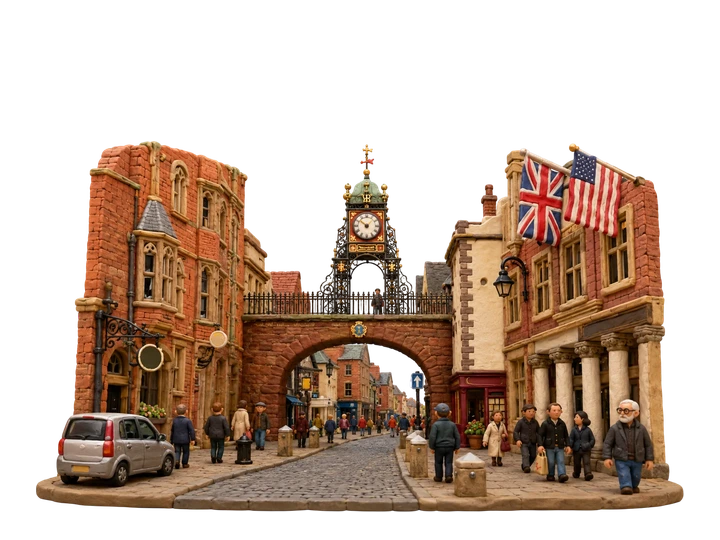
Read anything about Chester’s Eastgate Clock, the four-faced Victorian timepiece sitting above the Georgian Eastgate, on the line of Chester’s old Roman entrance, and you will, within about three sentences, run into the same line.
“The second most photographed clock in England, after Big Ben.”
It is everywhere. Wikipedia-style summaries say “England”. Chester.com says “the UK”. Cheshire West and Chester Council says “the country”. ChesterTourist goes all in and says “the world”. Hotels say it. Review sites repeat it. Stock photographers caption it that way. Even old travel blogs repeat it, because once a phrase has become civic folklore, it starts doing its own admin.
What none of them say is where the claim comes from.
There is no source. No survey. No methodology. No year. No “according to”. Not even a confident guess at a number. It is a piece of local tourism folklore that everyone has agreed to treat as fact, and which has been quietly upgraded over the years from “England” to “the UK” to “Britain” to, in the bolder write-ups, “the World”.
So I went looking for the actual number. How many times has the Eastgate Clock been photographed?
The honest answer is that nobody knows. Not even roughly. But the way you arrive at not knowing turns out to be more interesting than a number would have been.
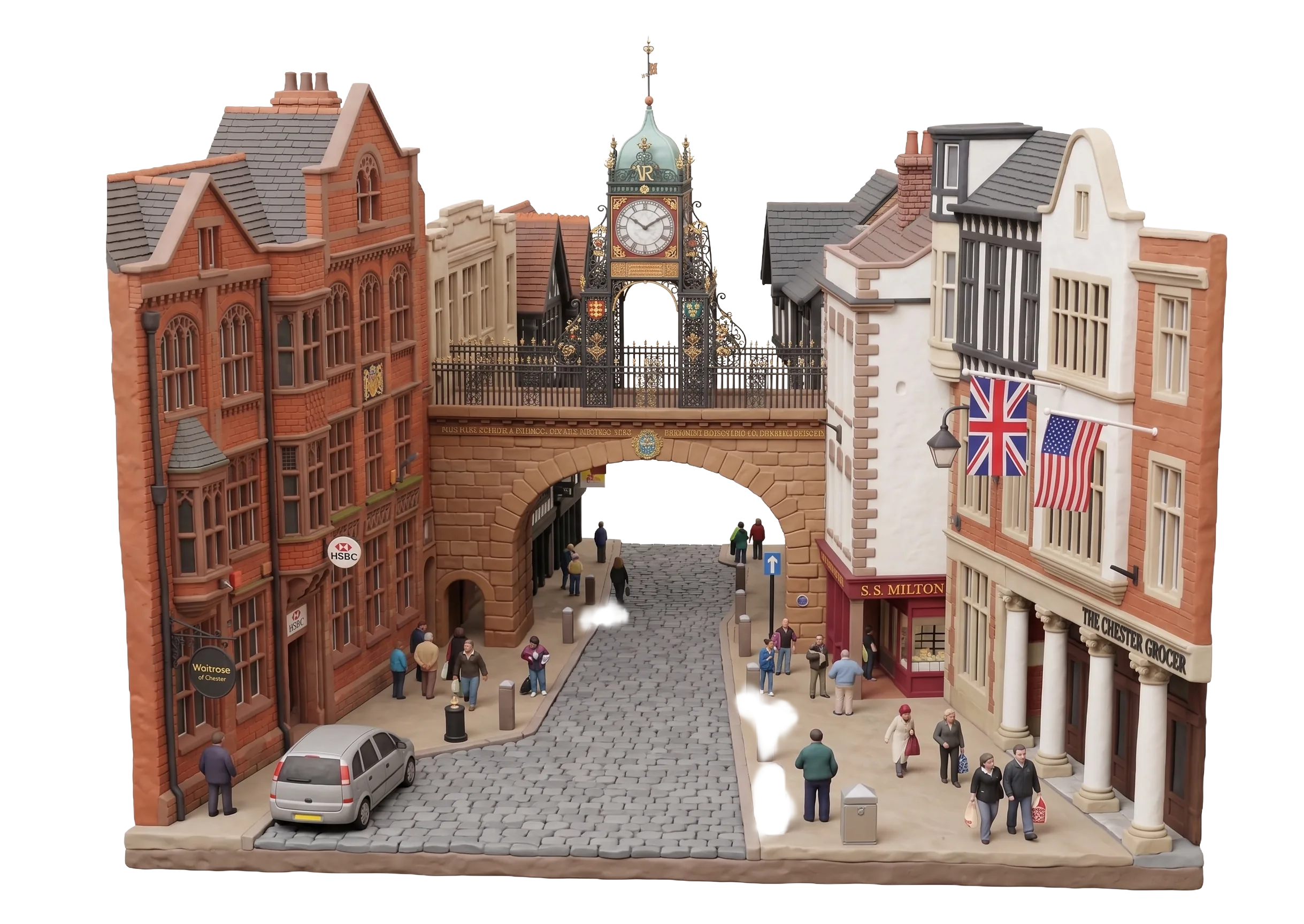
Eastgate Clock — Chester's most repeated clock fact starts here.
A Clock Born at Exactly the Right Moment
Here is the bit that genuinely stops you in your tracks.
The Eastgate Clock was officially opened on 27 May 1899, on what would have been Queen Victoria’s 80th birthday. Designed by the local architect John Douglas, with the mechanism made by J. B. Joyce & Company of Whitchurch, it had been put up to commemorate the Queen’s Diamond Jubilee two years earlier.
Eight months later, on 1 February 1900, Eastman Kodak launched the Brownie.
The Brownie was a cardboard box camera with a simple lens, a rotary shutter, and a price tag of one US dollar. It was the camera that helped turn snapshot photography from a specialist hobby into a mass habit. Before the Brownie, photography was mostly for professionals and wealthy hobbyists. After the Brownie, it was for anyone.
Which means the Eastgate Clock is essentially the same age as casual photography itself. It went up just in time to become one of the first British landmarks that ordinary tourists, with their own cheap cameras, could photograph for themselves rather than buy a postcard of.
That timing alone is worth pausing on. Most famous landmarks had to wait decades for the public to start photographing them in earnest. The Colosseum, the Tower of London, even Big Ben all spent years being shot mainly by professionals. The Eastgate Clock has been within range of an amateur lens for essentially its entire existence.
The Eastgate Clock did not just become photogenic. It arrived almost exactly when ordinary people started carrying cameras.
So, How Many Photographs?
Let’s try to estimate it. There are four reasonable ways to get to a number, all of which are wrong, but in different and informative ways.
1. Count the Visitors
Modern Chester gets millions of visits a year. Different tourism reports count the city, borough, day visits, overnight stays, repeat trips, and the wider Cheshire and Warrington region in different ways, which is exactly the sort of thing that makes a clean number start sweating.
The 2016 STEAM report put Cheshire and Warrington at 62.18 million visitors, with around 35 million visits to the Cheshire West and Chester borough. By 2022, the wider Cheshire and Warrington region was back above 50 million visitors. The problem is that none of this tells us how many people stood under the Eastgate Clock, never mind how many lifted a phone.
But the rough shape is clear enough: in the modern era, Chester is not a minor footfall town. It is a city that pulls millions of visits, and the Eastgate Clock sits on the single most-walked street in the centre.
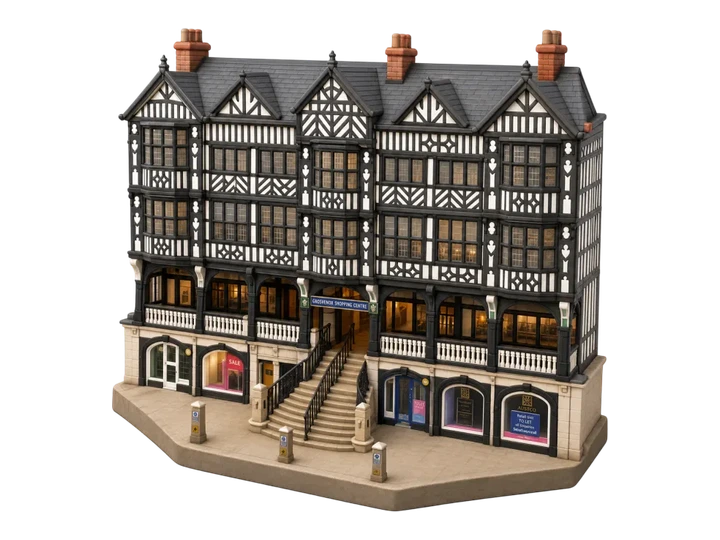
The Rows funnel directly toward it. Anyone walking the city walls passes underneath it. It is, geographically, almost impossible to visit Chester properly without standing within ten metres of it.
If even one in fifty modern visitors photographs it, that is already a large annual number. In the smartphone era, one in five may be too low. Across the clock’s nearly 127-year life, with photography volumes building from early box cameras to industrial phone-camera behaviour, the total starts heading into the tens of millions very quickly.
Plausibly twenty million. Possibly fifty. Conceivably much more.
2. Count the Stock Images
A quick check of the big stock libraries turns up hundreds of commercial images: iStock lists more than 200 Eastgate Clock Chester images, while Getty has around 90 under Eastgate Clock. That is still only the visible, licensed tip of the iceberg.
That matters because stock photography is a tiny filtered subset of total photographs taken. For every image that makes it onto a stock site, hundreds or thousands of near-identical ones sit on phones, laptops, cloud accounts and forgotten hard drives, doing nothing useful except waiting to be rediscovered during a storage panic.
3. Count the Social Posts
Search Instagram, Flickr, X, Facebook, TikTok, or Pinterest and you will find a large, untidy digital trail - but not one that can be reliably counted.
Travel blogs and image-search results add their own extra layer. Add up the findable, indexed, public digital images of the clock and you are still only counting the bit that left the house.
Now add every photograph ever taken of it that nobody uploaded, and the tracked numbers become almost meaningless.
4. Count the Postcards
This is the one that really opens up.
From roughly 1900 to 1950, the dominant way British tourists shared their travels was the picture postcard, and the Eastgate Clock was a publisher’s dream: newly built, gilded, photogenic, and sitting at exactly the right height to frame nicely.
Major postcard publishers produced Eastgate Clock views across the twentieth century, often reprinted and recoloured across decades. There is no central count of these, but there are certainly many distinct postcard views, some of them likely printed and reprinted in substantial runs.
That is an enormous photographic ancestry before you even get to Facebook.
So Is It Really Second to Big Ben?
This is where the original claim falls apart on inspection.
Big Ben is a credible “most photographed clock” candidate, although even there, nobody can actually prove it. London receives huge visitor numbers. The Elizabeth Tower is one of the most-shot objects in the world, full stop.
But “second” requires you to have somehow ranked the Eastgate Clock above:
- The astronomical clock in Prague
- The Rathaus-Glockenspiel in Munich
- The Zytglogge in Bern
- Grand Central’s clock in New York
- The Shepherd Gate Clock at Greenwich
- The Royal Liver Building clocks in Liverpool
- The Corpus Clock in Cambridge
None of those rankings exist anywhere. The “second most photographed” claim is not comparing the Eastgate Clock to anything. It is just a phrase that someone wrote down once, probably in a tourism brochure, and which everyone has been copying ever since because it sounds nice and nobody has much reason to push back on it.
What we can say honestly is this: the Eastgate Clock is one of the most photographed clocks in England.
Beyond that, it is myth. A charming, harmless one, but myth all the same.
Why This Clock, Specifically?
There is still a real question worth asking, which is why this clock got photographed so much in the first place. Plenty of British towns have nice Victorian timepieces. Most of them are not postcards.
A few things gave the Eastgate Clock its head start.
It sits at exactly eye-friendly photographic height: high enough to dominate the street, low enough that you do not need to crick your neck or use a wide lens to get it in. Big Ben is famously awkward to photograph well. The Eastgate Clock practically composes its own shot.
The arch beneath it is a natural frame. Stand on Eastgate Street and the clock sits perfectly inside its own ironwork pavilion, with the sandstone gate below. It is the kind of self-contained composition that postcard publishers and Instagrammers both love, more than a century apart.
The wrought-iron design by John Douglas is unusually intricate for a public clock: fleur-de-lis, acanthus leaves, the royal VR cipher, a copper ogee cupola. But it also photographs as a clean silhouette against the sky, which mattered for early black-and-white prints.
And, perhaps most importantly, it is directly above the busiest tourist artery in Chester. The Rows funnel toward it. The walls walkway crosses on top of it. There is essentially no route through the city centre that does not put you in front of it at some point.
Whether or not John Douglas knew he was designing a Victorian Instagram trap is a matter of debate.
The result is the same.
the Rows — The Rows do a lot of the clock's footfall work for it.
Fine. Let’s Actually Do the Maths.
Nobody else has bothered, so we did. Here is the model.
Take the clock’s nearly 127-year life and break it into eras of consumer photography. For each era, estimate annual visitors to Chester, the fraction who photograph the clock, and the average number of shots they take. Multiply. Sum. Try not to look too directly at what you have created.
| Era | Years | Visitors / yr | % who photograph | Shots each | Total |
|---|---|---|---|---|---|
| 1899-1914 Edwardian, early Brownie | 15 | 100,000 | 2% | 1 | 30,000 |
| 1914-1918 WWI | 4 | 20,000 | 1% | 1 | 800 |
| 1919-1939 Interwar | 20 | 200,000 | 4% | 1 | 160,000 |
| 1939-1945 WWII | 6 | 30,000 | 1% | 1 | 1,800 |
| 1945-1970 Postwar 35mm | 25 | 500,000 | 8% | 1 | 1,000,000 |
| 1970-1995 Mass tourism | 25 | 1.5M | 12% | 2 | 9,000,000 |
| 1995-2007 Early digital | 12 | 3M | 20% | 2 | 14,400,000 |
| 2007-2015 Smartphones arrive | 8 | 5M | 30% | 2 | 24,000,000 |
| 2015-2026 Instagram era | 11 | 7M | 40% | 3 | 92,400,000 |
| Personal photographs | 140,992,600 | ||||
| Postcard print reproductions | 2,500,000 | ||||
| Grand total | 143,492,600 |
So, if you accept a model made of assumptions, vibes, and one slightly overconfident spreadsheet, then as of approximately 9:47am on Friday 1 May 2026, the Eastgate Clock has been photographed 143,492,600 times.
This figure is, of course, complete nonsense.
The visitor numbers are ranges. The photo-rates are guesses. The postcard print runs are vibes. The real answer could plausibly be 50 million or 300 million. If you change the smartphone-era assumption from “40% photograph it three times” to “50% photograph it five times”, you add another hundred million by lunchtime.
But it is a number. And it is almost certainly closer to the truth than “second after Big Ben”, which has been the official answer for years and appears to have been made up by a tourism brochure with good instincts and no spreadsheet.
The Real Answer
The clock turns 127 later in May 2026.
It has spent every year of its life being looked at, photographed, painted, postcarded, filmed, scrolled past, and tagged. It has watched the whole history of consumer photography happen at its feet, from a one-dollar Brownie to a phone that costs more than a weekend in London.
It has probably had its picture taken more times in the last ten years than in its first fifty.
A hundred and forty-three million, give or take a hundred and forty-three million.
It just keeps time, and keeps getting photographed.
Sources Checked
Sources checked include Historic England’s National Heritage List entry for The Eastgate and Clock; Cheshire West and Chester Council; Chester.com; Visit Cheshire; ChesterWalls.info; Marketing Cheshire / STEAM visitor economy reporting; the Science Museum Group and The Franklin Institute on the Kodak Brownie; Getty Images; iStock; and selected local history and tourism pages repeating the “second most photographed” claim.
- Historic England: The Eastgate and clock
- Cheshire Now: Eastgate, Chester
- Chester.com: Eastgate Clock
- Cheshire West and Chester Council: Time for Chester
- Visit Cheshire: Eastgate Clock
- ChesterWalls.info: The Eastgate
- ChesterTourist: Eastgate Clock
- Cheshire West and Chester Council Annual Report 2016-2017
- Cheshire and Warrington tourism figures for 2022
- Science Museum Group: No. 1 Brownie box camera
- The Franklin Institute: Kodak Brownie Camera
- iStock: Eastgate Clock Chester images